Binaural Beats and Frequency Music: why they work better than Meditation
Have you ever noticed that 20 minutes of the right sleep music can help your body soften more easily than an hour of trying to meditate “correctly”?
For many people, binaural beats and frequency music become a simple form of self-care. They do not ask you to clear your mind or follow a strict technique. You simply listen, breathe, and let calming sounds guide your nervous system into a slower rhythm.
This kind of sound practice may support relaxation, deep sleep, emotional balance, and recovery after stressful days. And for those who find traditional meditation difficult, it can feel like a much softer place to begin.
What is Frequency Music?
Frequency music is audio created around specific sound frequencies, usually measured in hertz. You may have seen tracks described as 432 hz, 528 hz, 963 hz, solfeggio frequencies, or healing frequencies.
Different frequencies are often used for different emotional states. Lower sounds are commonly chosen for deep relaxation, sleep, and evening rituals. Mid-range frequencies, such as 528 hz, are often associated with restoration and heart-centered practices. Higher frequencies are sometimes used for clarity, focus, or a sense of spaciousness.
The experience is not only spiritual or symbolic. Sound affects the body in a very physical way. Your ears receive vibration, your brain processes rhythm, and your nervous system responds to tone, repetition, and tempo.
This is one reason why sound therapy can feel so immediate. A soft, steady sound can tell the body: you are allowed to slow down now.
What are Binaural Beats?
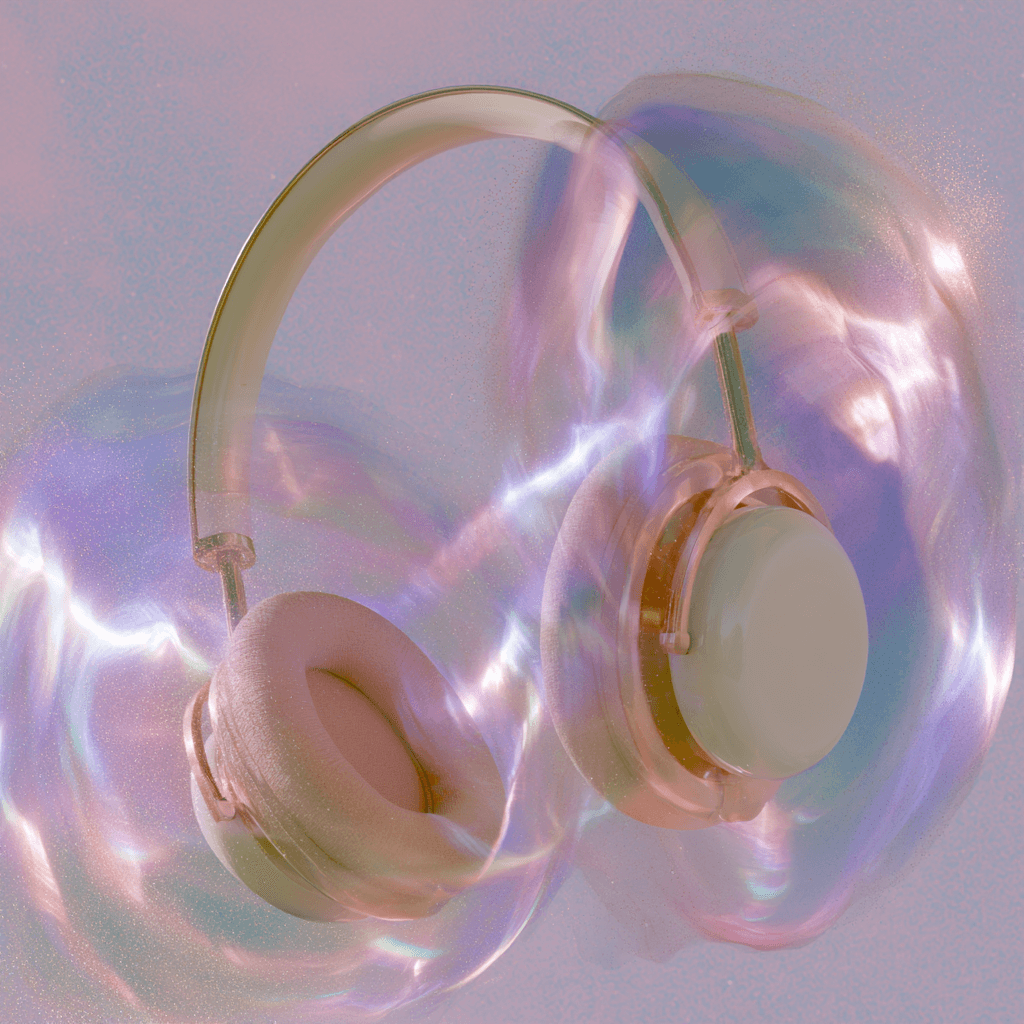
Binaural beats work in a slightly different way. They use two close, but not identical, frequencies. One frequency is played into the left ear, and another into the right. For example, your left ear may receive 200 hz, while your right ear receives 210 hz. Your brain notices the 10 hz difference and begins to respond to that rhythm. This is why headphones are important for binaural beats. Without them, each ear cannot receive its separate signal.
Depending on the frequency difference, binaural beats are often connected with different brainwave states:
Delta waves: deep sleep and physical restoration
Theta waves: meditation, creativity, and dreamlike states
Alpha waves: calm wakefulness and relaxed focus
Beta waves: concentration and active thinking
Low-frequency binaural beats are often used in the evening, before sleep, or during moments when the mind feels too active to settle on its own.
How Brainwave Entrainment works
The idea behind binaural beats is connected with brainwave entrainment. Brainwave entrainment means that the brain may begin to synchronize with an external rhythm, such as sound, light, or vibration. With binaural beats, the rhythm comes from the difference between the two frequencies played into each ear.
For example, if one ear hears 200 hz and the other hears 208 hz, the brain perceives an 8 hz difference. This range is often associated with alpha waves, which are linked to calm wakefulness and relaxed focus.
The effect can vary from person to person. Some people feel deeply relaxed within minutes. Others simply notice that sleep sounds or calming sounds help them settle more easily. The best way to begin is gently and notice how your own body responds.
" height="50px" id="mGSlyiJxm" width="50px"/><path d="M 0.418 0.064 C 0.153 0.334 0 0.755 0 1.299 L 0 20.73 C 0 21.275 0.153 21.696 0.418 21.966 L 0.483 22.025 L 11.651 11.141 L 11.651 10.884 L 0.483 0 Z" fill="rgb(20, 23, 34)" height="22.025399999999994px" id="jBw05nm4X" transform="translate(14.377 13.991)" width="11.65100000000001px"/><path d="M 3.718 7.517 L 0 3.887 L 0 3.63 L 3.723 0 L 3.806 0.047 L 8.215 2.493 C 9.474 3.187 9.474 4.329 8.215 5.028 L 3.806 7.47 Z" fill="rgb(20, 23, 34)" height="7.5168px" id="zBGqNLjFF" transform="translate(27.381 21.245)" width="9.15894999999999px"/><path d="M 15.04 3.711 L 11.233 0 L 0 10.953 C 0.418 11.382 1.099 11.433 1.874 11.005 Z" fill="rgb(20, 23, 34)" height="11.30166253361692px" id="KdKUQpjRU" transform="translate(15.471 25.679)" width="15.039500000000004px"/><path d="M 15.04 7.587 L 1.874 0.293 C 1.099 -0.131 0.418 -0.079 0 0.349 L 11.233 11.298 Z" fill="rgb(20, 23, 34)" height="11.297845571876222px" id="uo98QFET1" transform="translate(15.471 13.03)" width="15.039500000000004px"/></g></svg>)
" height="50px" id="wWHPSTFKj" width="50px"/><path d="M 18.336 7.644 C 18.305 4.321 21.127 2.704 21.256 2.629 C 19.658 0.357 17.181 0.046 16.31 0.022 C 14.23 -0.192 12.212 1.235 11.152 1.235 C 10.071 1.235 8.439 0.042 6.68 0.077 C 4.417 0.111 2.299 1.389 1.138 3.373 C -1.258 7.419 0.529 13.364 2.825 16.633 C 3.974 18.235 5.316 20.023 7.073 19.96 C 8.791 19.891 9.433 18.892 11.507 18.892 C 13.562 18.892 14.165 19.96 15.957 19.92 C 17.801 19.891 18.963 18.311 20.071 16.695 C 21.399 14.86 21.932 13.052 21.953 12.959 C 21.909 12.945 18.37 11.628 18.336 7.644 Z" fill="rgb(20, 23, 34)" height="19.961782934563374px" id="QkW07q_la" transform="translate(14.348 15.632)" width="21.952717572460607px"/><path d="M 4.042 4.217 C 4.966 3.089 5.599 1.556 5.423 0 C 4.085 0.058 2.412 0.902 1.449 2.005 C 0.596 2.976 -0.165 4.568 0.031 6.066 C 1.534 6.175 3.077 5.326 4.042 4.217 Z" fill="rgb(20, 23, 34)" height="6.075046314901501px" id="DAsGEchhR" transform="translate(25.257 9.286)" width="5.452511438717515px"/></g></svg>)
Binaural Beats for sleep and deep relaxation
Binaural beats for sleep are usually created around lower frequency differences, especially delta waves and theta waves.
Delta waves are connected with deep sleep and physical restoration. Theta waves are often associated with meditation, inner imagery, and the soft space between waking and dreaming. These states can be difficult to reach through effort alone, especially when the nervous system is overstimulated.
This is where sleep music and frequency music can become supportive. Instead of trying to force the mind to be quiet, you give it something gentle to follow.
You may find this helpful when your body is tired, but your thoughts keep moving. The sound becomes a bridge from mental activity into rest.
Healing frequencies: 432 Hz, 528 Hz
Many people search for healing frequencies such as 432 hz, 528 hz, or solfeggio frequencies when they want music for relaxation, meditation, or emotional balance.
These frequencies are often described symbolically. For example, 432 hz is commonly connected with harmony and grounding, while 528 hz is often called a frequency of restoration or heart-centered healing.
It is important to approach these ideas gently. Not every person feels the same effect from the same frequency. A track that feels deeply calming to one listener may feel neutral to another.
Rather than looking for the “perfect” frequency, begin with what your body accepts. Choose music that feels soft, steady, and safe. Your own nervous system will often know what helps it rest.

When to use Sleep Music and Calming Sounds
Frequency music, binaural beats, and sleep sounds can be especially helpful in moments when your body is tired, but your mind will not stop.
You may try them:
before sleep
after a stressful day
during periods of anxiety or emotional heaviness
while resting between tasks
during a quiet evening ritual
when meditation feels too difficult
when you want to support deep relaxation without effort
You do not need to force anything. Put on headphones, choose a soft track, lower the lights, and give yourself 15-20 minutes. If you are listening with children or sensitive listeners nearby, keep the volume low and choose calming sounds without sudden changes.
Frequency Music, Moon phases, and Lunar Rituals in Moonly
In Moonly, sound practices are connected with the rhythm of the Moon. The Moon Calendar can help you notice when your energy naturally rises, softens, or turns inward. Some lunar days may feel more active and expressive. Others may invite quiet, reflection, or release.
Frequency music can support these shifts. During the waning moon phase, softer tracks may help you slow down and let go. Around the New Moon, gentle sleep music can create space for rest, renewal, and inner quiet.
The Moonly app includes curated sounds, frequency music, binaural beats, and lunar practices created for different moods, moon phases, and moments of self-care. You can also ask Luna, your personal astrologer in Moonly, which practice may suit your current state, Birth Chart, or transit period.
How to start tonight
If you are new to binaural beats or frequency music, begin simply. Choose a low-frequency track, use headphones, and listen for 20 minutes before sleep. Let your breath move naturally. You do not need to meditate perfectly. You do not need to visualize anything. Just notice how your body responds. Maybe your shoulders soften. Maybe your breath becomes slower. Maybe nothing dramatic happens, but sleep comes a little more easily. Start softly. Listen with curiosity. Let sound become a small sleep ritual of returning to yourself.